Showing posts with label movies. Show all posts

1/09/2017

Whiplash, and Other Things

It's been a good long while since I posted anything, and for that I apologize. I moved into a new house, found out my wife was pregnant with our first child, and agreed to take in a Great Dane for an indeterminate amount of time, and had holidays to deal with, so that's my excuse.

But the time for excuses is over. I'm back, and I'm going to keep on building this site and going on unprovoked rants about things only I care about. So those of you who were hoping I had disappeared forever...tough shit!

***

I watched a movie today that really got my gears turning: Whiplash. It was up for Best Picture in 2015, and I usually try to see the best picture nominees, but this one slipped by me. Actually, that's not accurate; I saw Birdman, and it ruined my appetite for 'high art' for a while. Did I already write about Birdman? If not, maybe I will next week.

In any case, the end of Whiplash nearly gave me a heart attack. This is a story about what it means to be great, and it has all the hallmarks of great storytelling. It concerns the battle of wills between an aspiring jazz drummer, and the cruel teacher who ultimately brings out the best in him.

Whiplash | Final Scene (2014) from Wes Candela • Voices Film & TV on Vimeo.

This movie really resonated with me, because I played drums when I was younger. I was in concert band from 5th grade to Junior year in high school, and I did three years of jazz band in high school as well. In retrospect, I really wish I had pushed myself harder, because I always loved music, and even though I didn't really appreciate jazz at that age, I do now. If I had stuck with it, who knows what might have happened.

Our band teacher, who did concert and jazz, was easily as mean as Terrence Fletcher, but half as talented (he was a drunk too). After seeing Whiplash, I have a new understanding of the man, because I suspect that he, like Fletcher, cared deeply about music, and was frustrated with the hordes of his students who didn't.

I would give anything to learn at the feet of a teacher like Fletcher, because I believe in the argument that Whiplash makes. I believe that "good job" is the most destructive thing an artist can hear. I believe that greatness is born of adversity. I believe that great people need to be pushed, and that the greatest people don't need a mentor, they need an enemy. And that's what this movie was really about.

In the final scene, Andrew Neyman finally earns Fletcher's respect the only way he can: by defying him. And you can see it in Fletcher's face the moment he catches on (thanks in no small part to the amazing performance of J.K. Simmons). The battle of wills depicted in this scene is riveting enough, but set to the tune of a virtuoso performance of the jazz standard "Caravan" it's absolutely heart-stopping.

To me, it's obvious that Neyman's ultimate defiance is exactly what Fletcher wanted from him. But Fletcher could never let Neyman know that, or Neyman would have his permission to defy him, and that would make it easy. It would be just as destructive as saying "good job". Fletcher always knew that the student he was searching for would have to defeat him at his most vicious and cold-blooded. So when he sabotages Neyman early in the recital, he's giving his final exam. Neyman, thankfully, rises to the challenge, and gives the performance of his life. And Fletcher knows it almost immediately.

The game between Fletcher and Neyman works on two levels. There is the surface game of Neyman vs. Fletcher. In the final scene, it's boiled down to that simple rivalry; who is in control of the concert? But there is a deeper game at play: Neyman's potential vs. his hesitation, and that's the only game Fletcher was ever really playing. Neyman is meant to play the surface game, always suspecting the existence of the deeper game, but never being sure. The deeper game needed to stay hidden, in order to force Neyman into taking that leap of faith, and being sure of his own talent. To push him to that point, Fletcher needed to become his enemy.

The subtlety of that scene is masterful. None of the above is explicitly stated, but it's all there, plain as the nose on your face. Impossible to miss, in fact. That, friends, is the stuff of great storytelling.

I won't argue that Whiplash should have won best picture (though it was certainly better than Birdman). It was up against some hefty competition. Its subject matter is a little obscure to some people. And its story argument is an uncomfortable one. It makes us realize that most of us are mediocre. Most of us have never been forged in fire like this, even if we deserved to be. And it probably makes some of us (certainly myself) wish we had been, even if we didn't deserve to be.

In short, this movie was quite an experience for me, and I'm not likely to forget it soon.

3/14/2016

The Ten Commandments of Fiction Writing, Part Seven


As a student of the art of fiction, there are several axioms and pieces of advice that I come across again and again; "show, don't tell", "write what you know", "don't trick the reader", etc. These aren't items from a single book, they're everywhere. Some of them surely originate with specific authors, but as ideas they've taken on a life of their own, becoming more than something one person said.

In this series, I will try to gather all those admonitions, encouragements, and adages into a single, definitive list; the Ten Commandments of Fiction Writing. Hopefully this will be as fun and educational for you as it is for me.

-----

Commandment Seven: Thou shalt know thy characters and settings as thyself


We've all been told to write what we know (and if you keep reading this series, you'll be told again), but that axiom works in reverse too: know what you write.

Part of my problem with pantsing is that when you begin with a blank page, you begin with flat, undeveloped characters (Like this quote? Click here to tweet it!). You might put them into a dramatic situation, but you don't really know how they'll act, and without some kind of plan for character development, you're bound to miss a few opportunities. They might surprise you, which is good, but chances are they won't start surprising you right off the bat.

Characters are the core of your story, and they are the part that readers are most likely to remember. When I read Foxfire as a lonely teenage boy, I fell in love with Maddy and Legs. I missed them when the book ended. I missed them so badly that I actually wasted the time to see the god-awful 1996 adaptation. I don't know if Joyce Carol Oates is a plotter or a pantser, but she damn sure spent some time on the characters in Foxfire. They felt more alive and real than a lot of actual people I've met.

The issue is the same for settings. If you create a setting on the fly, chances are it's going to be pretty drab on the first pass. If you describe anything, it'll probably be the most obvious stuff, and that isn't what brings settings to life. Readers are savvy enough to fill in the obvious details on their own. The key is to provide the details that aren't obvious, and just enough of them to get the reader's imagination going. To do that, you have to get your imagination going.

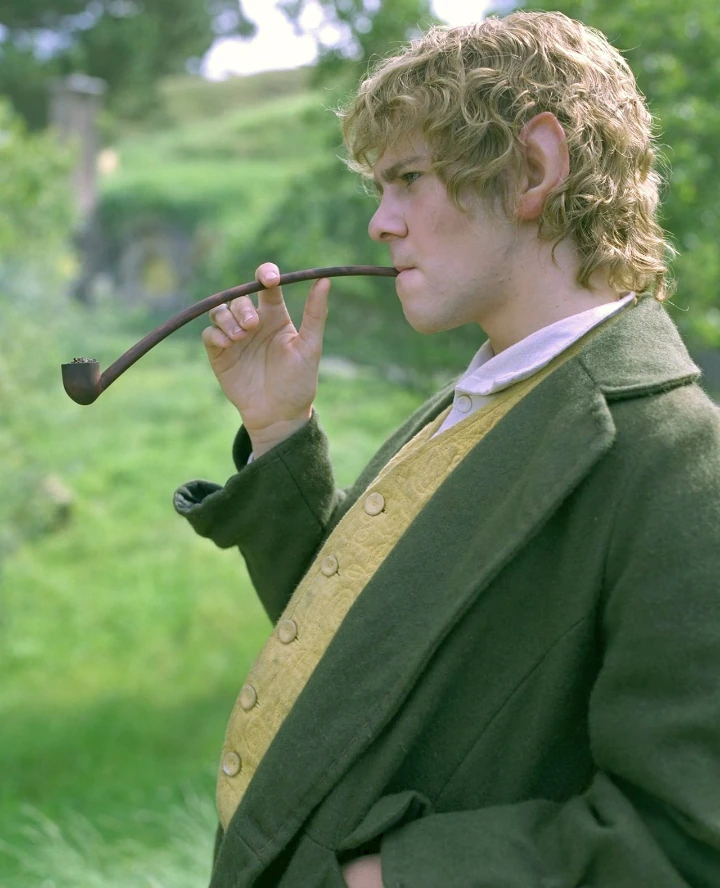
Settings aren't always the most important element of a story, but they can be powerful if you develop them well. Anyone who's read Lord of the Rings probably wanted to live in Middle Earth, orcs and all. I remember reading those books and vividly imagining all the food, drink, and pipe-weed the characters consumed--heck, I'd be lying if I said it wasn't part of the reason I'm a pipe smoker to this day. Little details like that made the world so real that a part of me never left. Tolkien definitely overdid it when it came to exposition, there's no question, but his setting became part of his reader's lives forever.

While I strongly advise restraint when it comes to including details about characters and settings, it never hurts to generate those details. The only way you can know too much about your characters and setting is if taking notes becomes an addiction, and keeps you from actually writing. And as a borderline OCD case, I can see where that would happen. But when you're plotting, it's worthwhile to research or create as much detail as you can. You never know when you'll see an opportunity for intrigue. It's the Pantry Method again; gather all the information you can, and only show readers the really interesting bits. The rest will be there if you need it, and if you don't so what?

For me, a well-defined task is essential. That's why I took the time to build templates to help me in this process. I've tried to ask myself every possible question, and when I'm plotting a story, I answer as many as I can. If that sounds helpful to you, Check out my Plotting Resources page, where you can download all of my plotting templates.

Even if you're not a plotter, you need to find a way to get into your characters and explore your settings. Without them, your book is a synopsis at best.

2/29/2016

The Ten Commandments of Fiction Writing, Part Five


As a student of the art of fiction, there are several axioms and pieces of advice that I come across again and again; "show, don't tell", "write what you know", "don't trick the reader", etc. These aren't items from a single book, they're everywhere. Some of them surely originate with specific authors, but as ideas they've taken on a life of their own, becoming more than something one person said.

In this series, I will try to gather all those admonitions, encouragements, and adages into a single, definitive list; the Ten Commandments of Fiction Writing. Hopefully this will be as fun and educational for you as it is for me.

-----

Commandment Five: Thou shalt not bear false witness unto the reader


This one is bound to stir up some controversy, but I'm pretty convinced of this rule. In short, you should never mislead the reader.

The operative word there is "you". You, the author, have a responsibility to the reader. Whether you want them to or not, they assume whatever you say is true, within the context of the story. Assuming you've written it clearly, they imagine things just the way you say them. If you then pull a switch on them, you break that trust. For the remainder of your story (and possibly your career) readers will be eyeing every word with suspicion, and that knocks them out of the story. Instead of focusing on your plot and characters, they're focused on figuring out what sort of tricks you're playing.

One of the most cited examples of this mistake is the technique of beginning with a false awakening. On one hand, false awakenings are a real part of human experience, so writing about them is justified in that sense. But on the other hand, they break a story's momentum right at the beginning. It's not fair to open on a dramatic situation, get readers into it, and suddenly tell them it's not real. (That said, I have been guilty of the false awakening beginning. But I had a reason: my story centered on a character who suffered from nightmares, which in turn fueled his chronic hypnophobia. Without a glimpse of his nightmares, I felt the hypnophobia would have been less believable.)

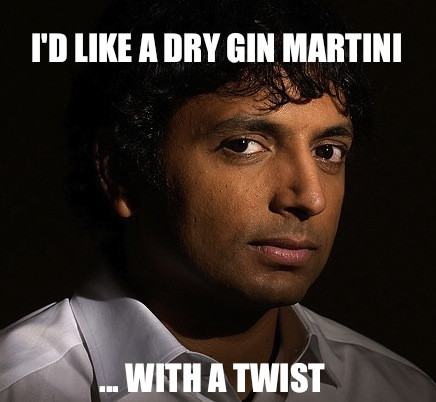
Similarly, the "twist-for-twist's-sake" ending (employed most famously in the works of M. Night Shyamalan) is almost always a poor choice. In most situations, a gigantic twist at the end of a story simply negates everything that came before it. It signifies that everything we've just read or watched didn't really matter. Who wouldn't feel betrayed by that?

If you're writing a mystery, misdirection can be good. In fact, some degree of it is expected. Mystery as a genre challenges the reader to figure out the truth before the protagonist does. But really, that's not the type of misleading I'm talking about here. In a mystery, a clue is presented as possibly true. The detective eyes every piece of information with suspicion, and so does the reader. And more importantly, the detective and the reader are aware of the same things. The detective does not hide anything from the reader.

What I'm against is unreliable narrators--unless they are a character in their own right. Let me explain. (If you've read my articles about Narrative Mood and Point of View, you might be able to guess where I'm going with this.)

If your narrator is going to lie to the reader, they have to have a motive. If the narrator is simply you, the author, then your only possible motive is to seem clever to the reader. True, readers do like surprises, but not when they arise out of an effort to be cute. It's the literary equivalent of a pun. Readers get it, but it makes them groan internally.

Readers expect a disembodied, non-character narrator to be impartial. Whether that narrator is omniscient or not, they exist merely to recount events as they happen. When they disregard that task, their reason for existing is called into question, and the fourth wall breaks down.

However, if your narrator is a character in their own right, they might have any number of motives to lie. As a character--even if they're not directly involved in the story--they are behind the fourth wall, and thus their disingenuous narration does not break the fictive dream.

As with so many of these commandments, this boils down to avoiding any practice which makes the reader aware of you instead of the story. The joy of reading fiction is that you become immersed in another world, and anything that threatens that threatens the joy of reading.

So don't lie to your readers. By all means, have your characters lie to them, but don't do it yourself. (Like this quote? Click here to tweet it!)

2/15/2016

The Ten Commandments of Fiction Writing, Part Three


As a student of the art of fiction, there are several axioms and pieces of advice that I come across again and again; "show, don't tell", "write what you know", "don't trick the reader", etc. These aren't items from a single book, they're everywhere. Some of them surely originate with specific authors, but as ideas they've taken on a life of their own, becoming more than something one person said.

In this series, I will try to gather all those admonitions, encouragements, and adages into a single, definitive list; the Ten Commandments of Fiction Writing. Hopefully this will be as fun and educational for you as it is for me.

-----

Commandment Three: Thou shalt not intrude upon the story


Author intrusion is one of the most common and irritating mistakes made by writers. And it's not limited to amateurs, or even to writing; if you've ever watched a movie and been annoyed by an incessant voice over explaining every little nuance of what's going on, you've been a victim of author (filmmaker?) intrusion.

Dave King and Renni Browne deal with this issue in Self-Editing, when they give the editor's maxim R.U.E - "Resist the Urge to Explain!" When an author intrudes on her story to explain something, she commits three crimes: a) she underestimates her own ability to show what's going on, b) she assumes her readers aren't attentive or intelligent enough to get what's going, and c) she assumes that the readers need or want to know every little nuance of what's going on. Let's look at each crime in turn.

First, if you're over-explaining because you lack confidence, either you aren't a very good writer, and you should take some time to hone your craft, or what you're writing is too complex. If you're falling all over yourself trying to explain it, maybe you should pull back and look at what that event's job is in your story. Can that job be done by a simpler event? If several things are happening at once, can you find a way to spread them out so you can write them more simply? Don't go beyond what's absolutely necessary unless you have a very good reason. And if you must, it's worth taking the time to break scenes down into their essential parts, and figure out the most direct way of putting them across.

If you're over-explaining because you're afraid readers can't figure it out on their own, complexity may still be an issue. But it might just be that you're not giving the average reader enough credit. Remember, readers are smart. Reading makes you smart. Writing down to your audience is a sure way to alienate them. To paraphrase Browne and King, resisting the urge to explain pays readers the compliment of assuming they're intelligent.

If you're over-explaining because you assume the reader wants all this information, I've got some news for you: they don't. By and large, readers (and movie audiences) prefer to have just what they need to understand what's going on. Deeper understanding usually comes only with repeated readings, which is a sign of commitment to a particular story. You can't expect everyone who picks up your book to commit to it in this way. Not everyone is going to turn into a fanboy of your work. By force-feeding the reader more detail than they want or need, you force them to become a fanboy just to understand the basics. It's like asking someone to marry you on a first date. (Like this quote? Click here to tweet it!)

Over-explanation is just one form that author intrusion takes. Purple prose, tangential narrative, excessive description, and ham-handed characterization and exposition can all be forms of author intrusion. In fact, anything that distracts from the story in order to serve the author's whims is intrusion. Any time you get in the way of your story, you are unwelcome.

So don't write fancier than you have to, just write clearly. Don't take detours just to show us some neat idea you cooked up; make the idea matter, or don't include it. When describing things, provide just enough detail to get the reader's imagination going, then get out of the way (my Inverse Coco Chanel Principle will help you achieve this). Don't dump mounds of backstory on your readers, let them get to know your characters and settings gradually, they way they do with real people and places. It isn't just easier to read, it makes your world seem more realistic. And for God's sake, don't base a character on yourself and then expend huge amounts of time on that character, it makes you look desperate.

That's what it all comes down to: author intrusion makes you look desperate. Which is understandable, to some degree. We write because we want to be known. If we didn't want attention, we wouldn't write. But overdoing it will drive readers away just like overdoing it in social situations drives potential friends away. Remember that you are part of everything in your story, and everything in your story is part of you (Like this quote? Click here to tweet it!). There's no need to put on a silly costume and dance for your readers. If they are reading your book, they are reading you.

Let them!

2/08/2016

The Ten Commandments of Fiction Writing, Part Two

As a student of the art of fiction, there are several axioms and pieces of advice that I come across again and again; "show, don't tell", "write what you know", "don't trick the reader", etc. These aren't items from a single book, they're everywhere. Some of them surely originate with specific authors, but as ideas they've taken on a life of their own, becoming more than something one person said.

In this series, I will try to gather all those admonitions, encouragements, and adages into a single, definitive list; the Ten Commandments of Fiction Writing. Hopefully this will be as fun and educational for you as it is for me.

-----

Commandment Two: Thou shalt show, not tell


You've heard it before. If you've read my article on Scenes and Narration, you know what it means. Stated as succinctly as possible, showing is like watching a movie, and telling is like reading the Wikipedia synopsis.

You know showing is important, but are you willing to commit to it?

One thing I never read in articles about writing is how hard it can be to force yourself to show, when telling is so easy. It can be tempting to just brush through a series of events with narrative summary. But if you truly believe that story is the highest goal, you put your own concerns behind those of the story, and soldier on.

Showing means more time at the keyboard. And that should be good, right? I mean, we're writers. We like writing, don't we?

The truth is, not all of us love writing every day. Sometimes it can be hard work. Sometimes the muse won't show up. Sometimes our attention is elsewhere. These are moments when the temptation to tell is greatest.

When you're on fire, it's easy to write scene after scene, Hell, it's harder to stop than it is to keep going. When you're having a good day, scenes, images, and actions seem to flow through you. They may even feel like they're not coming from you at all. During these times, showing is easy.

"Show, don't tell" is more than a technique, it's a lifestyle (Like this quote? Click here to tweet it!). It's about finding the right combination of elements that keep you in that productive mindset. And when it's not working, shake things up a bit. A change of location can work wonders; even if its from one side of the couch to the other. Breaks are important too; you want the Archimedes effect working for you when you're not actually at the keys.

It's hard sometimes, but it's worth it. The fictive dream is a powerful, magical thing, and you can't get a reader into it by telling. You put a lot of information across when you tell, and readers will know the story. But if you want them to experience it, you have to show them.

1/25/2016

Proportion

First off, I'd like to apologize for taking a break last week, I've been trying to wrap up some freelance work that's been hanging over my head. But I'm back, and I've got a lot cooking.

Next week, I'm going to debut a new series of posts called The Ten Commandments of Fiction Writing. They'll likely be shorter posts than usual, but hopefully it'll be a fun way to look at some fundamental issues. Stay tuned!
----------
This week I want to talk about a concept that revolutionized my understand of fiction: Proportion. Like many important concepts, proportion was first introduced to me by Dave King and Renni Browne, in their book Self-Editing for Fiction Writers, which is one of the most important parts of my Writing Bible. It's another one of those ideas that seems obvious once you've been told about it, but before that you probably never thought of it.

Simply put, proportion is about controlling how many words/paragraphs/pages you spend on what. The more time you spend talking about a thing, the more important it will seem to readers, and the more likely they'll be to remember it after they finish the book. Proportion works on a macro scale and a micro scale. Let's take a look at the macro scale first.

In Self-Editing, Browne and King give a great example of proportion on a macro scale. It goes something like this: A woman wrote a very long novel, and her editor told her to trim it down by cutting out some of the less relevant scenes. So the writer cut out all the cooking scenes, all the shopping scenes, all the driving scenes, and everything that she had added 'just for flavor'. The book, while not necessarily 'romance', centered on a romantic relationship, so the author left all the sex scenes in, as she felt they were relevant to the plot. The result was that by simply cutting a handful of scenes out, her novel had transformed from a work of contemporary fiction into a steamy work of erotica. Her editing had thrown the book out of proportion.

When you're writing a novel, it's easy to forget exactly what you've already written. We don't write novels in one go, it's a process of weeks, months, years, even decades. But for readers, a novel is a much more compressed experience, and if they hear about a thing over and over during that time, they will naturally assume it's important.

If you write with an awareness of proportion, this can work to your advantage. Your main character is the most important, so you spend the most time in his or her point of view. If your theme revolves around the ugliness of war, you can and should spend a lot of page time depicting grisly scenes of battle and human suffering. If your theme is about love, you can and should spend more page time on scenes of your romantically-entangled characters doing whatever brings them together.

But since we write novels over a period of time, we sometimes forget what we've already emphasized, and this can lead to proportion problems. In my current work-in-progress, I'm exploring my character's motivations for remaining faithful to his religion, even though he's a bit of a misfit in the church. I have a number of scenes where he introspects about how the church (and God) saved his life when he was younger, and how he feels a great debt and responsibility to the church because of this. After having several people beta-read the novel, a couple of them asked if this novel was just my way of proselytizing about Christianity. And that wasn't my aim at all. But because I spent so much page time on a character affirming his faith, the book seems like an endorsement of that faith.

Now that I'm to the editing stage, I can go back and trim out, or at least trim down a few of these scenes. I can make sure I don't repeat myself, and ultimately I'll bring everything back into proportion.

On a micro scale, proportion affects how easily a scene reads. Many of us have read books where the author gives us a blow-by-blow account of something relatively mundane.

Jason inserted his key into the lock and turned the knob to the right, The door opened and he stepped inside. The smell of roasting chicken greeted him. He set the mail and his keys on the table by the door, then rounded the corner into the kitchen.
"Smells amazing," he said. 

This passage could just as easily have read:

The smell of roasting chicken greeted Jason when he walked inside.
"Smells amazing," he said as he rounded the corner into the kitchen.

Even if the facts are important, we don't always need to read about them in detail. Readers are smart, on the whole (because reading makes you smart), and they can fill in some of the details themselves. Browne and King use an example where a man is rescuing another man from a river. The scene describes the rescuer's movements as he throws the injured man over his shoulders and traverses a series of logs to get to shore. It's an exciting moment, but the author spends so much time detailing how the rescuer hops from one log to another that you start to get bored. Browne and King suggested the author condense all that action down into a single sentence: "He made his way across the logs."

There are two good reasons to watch your micro scale proportion. First, you don't want to bore readers by making them read every physical action your character goes through, or every thought that passes through their head (that's one I see a lot in my editing career). Second, you don't want to rob the reader of the opportunity to fill in the gaps themselves. It's one of the joys of reading. If an author writes a tense dialogue between two characters, but leaves out most of the internal monologue, I get to experience the pleasure of imagining what each character might be feeling.

Take this famously tense scene from Quentin Tarantino's Inglorious Basterds. In it, we watch in horror as Hans "The Jew Hunter" Landa has a seemingly civil conversation with a farmer about a missing Jewish family. As the scene develops, we see the farmer growing more and more nervous, yet Landa remains cool and calm. By the time we're a couple minutes into their exchange, we know the farmer is either hiding the missing family, or knows where they are. But the conversation never explicitly tells us that. We pick it up purely on subtext, by watching the characters' body language. Imagine if Tarantino had cut into that scene with an obnoxious voice-over and explained what each character was thinking. Wouldn't that completely take the wind out of the scene's sails?

That type of voice over would be the cinematic equivalent of author intrusion (which I touch on in this article), but it's a proportion issue as well. Don't spend precious page time telling readers the things you could be showing them. And don't waste time showing them anything they can supply on their own, because it saps the joy out of the experience.

Properly proportioned stories hold our attention. They don't take detours explaining things we don't need to know, or waste our time showing us things we could skip.

1/11/2016

A Writer's Look at Star Wars: The Force Awakens


If you're breathing at the moment, you've heard the buzz about Star Wars, Episode VII. Matter of fact, you've probably already seen it. If you haven't, you can't really complain about the spoilers that follow. Get off your ass and see the movie.

Consider yourself warned.

In my lifetime, there has never been a movie like this. Every year sees a handful of hotly anticipated movies; some sequels to successful blockbusters, others high-minded Oscar hopefuls, still others adaptations of already well-known works. But if you added up all the anticipation for every movie that's come out since I was born, it wouldn't even come close to the buildup for Episode VII.

And that, in itself, made it possibly the greatest writing challenge I've ever witnessed. The prequels were big news, sure, but once that first one hit theaters, we were all rolling our eyes for the remaining two. Star Wars has been big business since day one, but those movies--even before we knew they sucked--didn't have the kind of energy around them that Episode VII does. It was like "Hey, they're finally making a new Star Wars. Cool!", and that was about as excited as any 'normal' person got.

But after the travesty that was Episodes I-III, the stakes done got raised. On the one hand, you had what was arguably the most beloved and world-changing media franchise of all time, and on the other, you had a flaccid, blatantly commercial prequel trilogy that just took a massive Cleveland steamer on the whole thing. Never has the ache for redemption been so strong.

I got my hopes up when I heard the important players from the original cast were coming back. That was the first sign, to me. If they had made another Star Wars without Harrison Ford, I would have seen it out of a nerdy sense of duty, not genuine desire. But the cast did come back.

The next worry I had was "Who's writing it?". Perhaps it's professional bias, but to me, the writer is more important than the director (ideally, they're the same person, but I knew this project was going to be a team effort). As long as a director is professional, and doesn't get up his own ass with technique-y gimmicks (I.E. Alejandro González Iñárritu), most directing styles are tolerable to me. Even, mood permitting, that of the much-maligned Michael Bay.

When I watch a movie, I can't help seeing right past the veneer of characterization, exposition, setting, etc, right to the narrative structure. I like stories that display symmetry, minimalism, and a clear causality. I like my stories to have everything they need, and nothing they don't. So I was happy when I learned that J.J. Abrams was in charge, along with help from George Lucas's old pal Lawrence Kasdan, and Pixar alum Michael Arndt. That is a satisfying meeting of minds, and I think it produced a winning script.

The Force Awakens has been criticized for being too similar to A New Hope, and I think that's a somewhat valid note. We have a lonely youngster on a desert planet, with tenuous ties to a family they hardly know getting swept up in an interstellar conflict; a Big Bad in black who will do anything to squash the emerging threat to his power; an adorable droid sidekick who needs to get to his master; a somewhat grizzled mentor character who convinces the hero the force is real...I could go on. We even begin the same way: resistance hero gets in a sticky situation and has to hide a crucial piece of information by giving it to a droid, who runs off and fortuitously meets up with our protagonist. And the climax is the same too: A ragtag group of rebels, spurred on by the cruel display of the badguys' power, locate and exploit the one weakness of the weapon that created said display.

I could go on.  For a long while.

It's true that a lot of things will look too familiar to some. But to me, these things are more about narrative symmetry and paying homage than they are about being derivative. Taking notes from Episode IV was a sound strategy to ensure a higher quality story. I would have done the same. In fact, that's all I know how to do: take inspirations, beats, and elements from high-quality source material, mix them up, and add a few new things. I'm a big believer in the old saying that there's nothing new under the sun, but it doesn't bother me, because shuffling familiar elements has a way of producing sound, likable stories, and the forces of chaos ensure just enough new, fresh material to keep things interesting. So I'm glad that Episode VII took more than a few notes from Episode IV. Anyone who has a problem with something reliably good is a masochist.

The visual element was important to me too. One of the biggest problems with Episodes I-III was that all the CGI was so shiny and fresh looking, it broke the fourth wall. All I could see was special effects. I couldn't see the characters at the heart of it. But it would seem that we've finally entered an era where technology has caught up with the goals of the filmmakers that use it. I can still tell what's CGI in Episode VII, but only because I know what's possible and what's not. just to look at it, the seams don't show at all, and that kept me in the movie.

Structurally, the movie is rock solid. Its characters have the vibrant, timeless quality that made the original engaging. Rey is a great hero; I'm a sucker for a tough chick that can hold her own in a fight; something that Star Wars has always been known for (I.E. Leia). Klyo Ren has been lampooned for being too 'emo', but I actually like that about him. I think his volatility makes him more dangerous, and it keeps him from being just a clone of Vader. His voice under the helmet even makes me think of Tom Hardy's Bane, but at a Teen Titans age.

I was sad to see Han go, but again, I probably would have done the same. Someone had to die to lend credibility to Kylo Ren's villainy, and if you're gonna kill somebody in a story, you've got to make it hurt the audience as much as possible. I can't imagine any Star Wars death that would affect fans more.

The most intriguing things about Episode VII were our two new mysteries: the identity of Supreme Leader Snoke, and the identity of Rey's family. Personally, I think Rey's situation is obvious to anyone who was paying attention. She's a Kenobi, through and through. My money is that she's Obi-Wan's granddaughter. They dress the same, they have the same self-possessed confidence, and when I saw Rey climbing around an area of Starkiller Base that was very reminiscent of the first Death Star, it clicked. And it made the end of the movie all the more poignant: once again, we have a calm, wise Kenobi handing a troubled Skywalker his weapon, beckoning him back into the fray.

Snoke bugs me though. Andy Serkis, who portrayed him in the movie, assured us that Snoke is a completely new character, but I find that unlikely. First of all, it strains against believability; that someone hitherto unknown in the Star Wars universe had the motive, means, and opportunity to attempt to rebuild the Galactic Empire seems crazy to me. How does he have the resources? How does he have the connections? Why does he even want to?

It seems more likely to me that either Snoke is someone we already know, or he has a connection to someone we know. Otherwise, the stakes just aren't high enough. Emperor Palpatine was a mighty, thoroughly intimidating villain who held the galaxy in an iron fist for six movies. He was damn hard to defeat; if it wasn't for Anakin Skywalker's last-second conversion, he probably wouldn't have been. It was one of the narrowest victories ever. And Snoke has to top that, otherwise the third trilogy will actually lower the stakes. I just don't think that a total unknown can come onstage and be more evil and manipulative than the Emperor. Palpatine is up there with Satan when it comes to embodiments of evil. He's so evil, he's a metaphor for evil. So Snoke better have some serious chops, or it will subtly ruin the new trilogy for me.

That said, my hopes are high. J.J. Abrams knows how to spin a web of lies and confusion in order to keep the audience guessing. Lawrence Kasdan knows how to honor the movies that came before, and make use of the best elements in them. And Michael Arndt knows story structure, and has a knack for creating bright, engaging, sympathetic characters. As long as those minds are involved--or at least minds of similar quality--the forthcoming movies will be great.

12/28/2015

Editing for POV

Point of view is one of the most subtle and powerful tools in the writer's toolbox. It's also one of the most troublesome.

I would guess 90% of the work I read from my peers and clients has at least some POV issues. Whether it's an unclear POV, too much narrative distance, or unwelcome POV shifts, most writers struggle to master POV. I myself, have yet to master it, but I've found it helpful to draw some very clear borders between POV types. I've already written a lengthy article on the subject, but let me go over it again.


I distinguish between two main types of POV, each with their own sub-types:

  • First Person - "I"
  • Third Person/Omniscient - "He", "She"
[Note: In the aforementioned article, I discuss Second Person as well. It plays a role in other POVs, but I do not consider it a viable option for an entire work of serious fiction]

With first person, you have two main subtypes:

  • Present tense, where the POV character narrates events as they happen
  • Past tense, where the POV character is recalling events that have already happened to them.

When I'm working in first person past, I always decide on some definite period of time between the events happening to the narrator, and the narrator relating those events. It helps me decide how much perspective to provide. If the narrator has just finished living through the events, they won't have as much perspective as they would if they were separated from the events by several years. The narrator's feelings on the events will color the prose, and that color deals with a concept I call Narrative Mood (see this article for more on the subject).

Another first person subtype related to mood is the conversational style. But conversational first person isn't as simple as you'd think. When considering any POV, you need to ask yourself whether the narrator is aware that he or she is narrating, and in turn, if he or she is aware of who they are narrating to. It might also be helpful to ask if the narrator is aware of the medium in which the story is delivered, or if the narrative is a transcript of some other means of delivery.

For example, does the narrator know their words are being read as a book, or are they speaking the whole story aloud to a fictional audience? In an epistolary novel like Dracula, the narrative may well be in first person, and the narrator may well be speaking to an audience, but the narrator is not necessarily aware of the reader, nor that his or her narration is being read as part of a story. Additional dimensions like the epistolary technique can enhance a story's sense of realism, but they also require an extra degree of care on the author's part.

I view third person as a sliding scale, with narrative intimacy on one side, and narrative distance on the other. A story written in an intimate third person will read very similar to first person, just with different pronouns. All events will be filtered through a single POV character at a time. You can have multiple POV characters, but in every case, the POV character is distinct from the narrator (more on that in a moment). A story written in omniscient sacrifices almost all of its intimacy in the name of perspective. Omniscient provides more facts about the story, but less emotion, and less character. It has its uses, but it's difficult and risky, because it's often less engaging to the reader.

In most forms of third person, the narrator is a faceless, nameless non-being--a camera, essentially--who exists for the sole purpose of conveying the story. This camera can be zoomed in or out as needed, and that is the true strength of third person narrative. But it's important to understand what the camera can and can't see, and to know when the camera should be turned on and off.

It is also possible for a third person narrator to have a personality, and this can be particularly effective in omniscient. It has been done to great effect by the likes of Charles Dickens and Douglas Adams. A third person narrator might also be a non-central character in the story, like Ishmael in Moby Dick.

The main thing in all this is to take time to carefully consider who or what your narrative voice is, what spatial and temporal relationship they have with the events of the story, and what feelings, if any, they have about the events.

These decisions are best made during the plotting phase of your story, because it's a lot of effort to change your POV after the fact. But that doesn't mean there's no POV work to do during the editing phase.

In most cases, a POV change in the editing phase will necessitate rewriting the story entirely, or close to it. But there are very good reasons to do it. First off, you should always choose the right POV for the story, not just whichever suits you best. It's better to change your writing to serve the story than vice-versa. (Like this quote? Click here to tweet it!). Second, even if you're an obsessive plotter like me, you won't always know exactly where your story is going. You might go on a detour that changes the essential nature of your story, or makes one character more important than originally intended. When this happens, sometimes it's necessary to change the POV to suit the new story.

Say you started off in a fact-laden omniscient, but as the plot developed, you found yourself falling in love with a particular character, and following them more than others. It's probably worthwhile to consider rewriting the whole story through that character's POV, either by making them a first person narrator, or by developing an intimate third person relationship with them.

If you're happy with your original POV choice, that still doesn't mean there's no POV work in the editing phase. Even if you're skilled in this area, you need to read your manuscript with a keen eye, to make sure you haven't written any accidental POV shifts.

Third person allows you to throttle the narrative distance up and down, but the transition needs to be smooth. It works just like zooming a camera lens in and out. Professional film makers modulate the distance of each shot, and zooms are a common technique, but it's rare to see a fast zoom in or out because it's jarring to the eye. The same is true in novels; rapid, careless modulations of POV are jarring to the mind.

It's also important to make sure POV modulations are warranted. If most of your novel is written with a fair amount of distance, but you have one important, steamy love scene, or an important, heated battle scene, it's probably worth it to zoom in on the character, and temporarily close that narrative gap. But if the scene isn't that important or intense, leave the distance where it's at.

...

Editing for POV is tough. There's no two ways about it. But like most tough things, it's worth doing. A well-controlled POV will distinguish you as a professional.

12/21/2015

Be Forewarned

Simultaneous original creation is one of the surest signs that there's nothing new under the sun. For example, the first novel I ever wrote was a sprawling, experimental mish-mash about several people from different points in human history being magically transported to a supernatural realm, taking part in a handful of strange trials, and ultimately providing the impetus for the apocalypse. I quiver with embarrassment at how juvenile my writing was back then. I, like many first time authors, was so intoxicated by the act of creation that I never paused to consider my story's inherent flaws, or how my writing might be improved.

Then one day, I bought a copy of Into The Electric Castle by the Dutch band Ayreon. It was an extended prog-rock opera that told the story of several people from different points in human history being magically transported to a supernatural realm, taking part in a handful of strange trials, and ultimately providing the impetus for the apocalypse.

And it was absolute garbage. (Listen to Ayreon's prodigious excess on Youtube)

Don't get me wrong, Ayreon brings together a diverse and talented group of musicians, all of whom are virtuosos in their own right. In terms of technical ability and musical composition, the album is a triumph. But there isn't a single truly memorable moment in its 100-minute run time, and the story is ham-fisted, trite, and full of mind-numbing exposition. And this made me realize that my first novel suffered from exactly the same problems. (The whole album might be tongue-in-cheek, and in that case it's probably a masterpiece, but to me it's impossible to tell)

If you've been writing for a while, you may have been through something similar. I'm convinced it's a necessary learning experience. The simple fact is, there are only so many stories the human mind is capable of telling. Depending on how you break things down, there are as few as seven.

That doesn't mean there's no hope, though. People create original, engaging stories all the time. I'm even arrogant enough to think that I've managed it once or twice.

Unfortunately, I can't really tell you exactly how to avoid cliche, and I doubt there's anyone out there who claims to have the recipe for originality (having the recipe kind of precludes the idea of originality, doesn't it?). However, there are plenty of resources when it comes to avoiding cliches. Some stories have been told and retold--usually with the best of intentions--so many times that people started recognizing the pattern, and speaking out about it.

Strange Horizons, an online speculative fiction magazine, keeps an archived list of "Stories We've Seen Too Often", and it's a great warning for spec fic authors like my illustrious self. I am guilty of writing or planning to write two or three of the things that appear on this list.

Writers find inspiration everywhere. I often find it in movies, books, and the struggles of daily life. But it's important to remember that many, many people have access to the same sources of inspiration as you. It's not unusual for two people separated by time and distance to arrive at more or less the exact same idea. So it pays to be aware of what's already been done to death, and save your poor tired fingers from banging out a story that was already done to perfection thirty years ago. While you might still want to write your own telling, awareness will help you temper your expectations for the story's performance on the open market. Writing is never a waste of time--I mean that, never--but trying to sell a story mired in cliche is an emotional flogging you could do without.

If you're a spec fic author, and you're thinking about submitting your latest work, take a look at Strange Horizons' list, and save yourself some pain and anguish. But don't feel guilty if your story is on that list! It's a natural part of the process; like falling off a bike. If you keep getting back on, and keep learning from your mistakes, there's no reason you can't get to the Tour de France.

8/20/2015

A River Runs Somewhere in the Vicinity of It

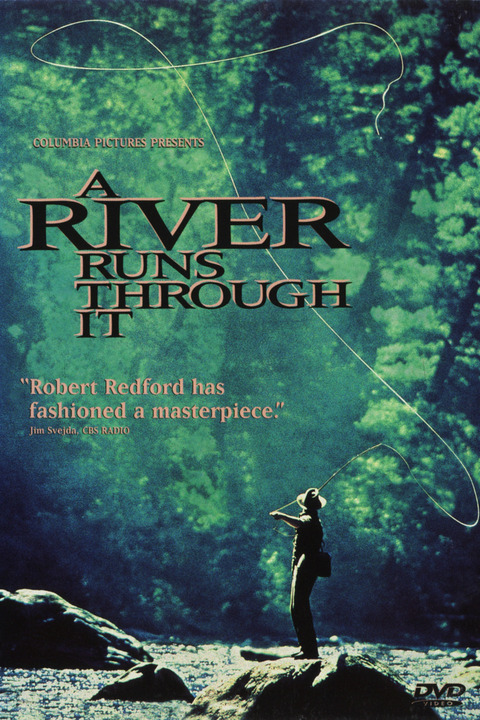
So the other day, my lovely bride and I watched the critically-acclaimed Robert Redford film A River Runs Through It. Any of you who have been alive since the late 80's or so will have heard of this film.  I remember it being very well-received when it came out, and people talked about it a lot.

Somehow, I never saw it.  It was one of those classics I just missed along the way.  That's happened a lot in my life.

For the last few weeks, whenever we watch a movie, I try to analyze its story structure.  Most of the time, I even pull up this little list I keep in my phone, to track the writer's use of archetypal scenes that tend to appear in properly structured stories.  It's by no means an exhaustive or universally applicable list, but these scenes are general enough and familiar enough that this structure can be applied to most movies and novels out there, whether the writer was aware of it when they wrote the story or not. (For a complete look at my list, check out my series on Story Structure)

So as we watched the tale of the Maclean brothers, I was on the lookout for a clear three-act structure, a revealing midpoint scene, and some sort of character arc expressed in a handful of key scenes.

To be frank, I found none of this.  Instead, I found a lot of narration about what the world was like in the eras the story is set in (nearly all of which was crammed into the first third of the film), and not a whole lot of scenes that show us what the world was like in those eras (Post WWI, into the Prohibition Era).  Not only did the first part of the movie rely too heavily on narration, but there didn't seem to be any main plot established.

There were a few scenes in the first half of the movie where I thought "Oh, this is what this movie is going to be about", but none of them really ever led to anything.  When Brad Pitt's character Paul brings a Native American girl to the speakeasy, I thought maybe this was going to be a movie about racism.  But after that scene, the town's disdain for Native Americans is never mentioned again.  There was a scene where Craig Scheffer's character Norman comes to bail brother Paul out of jail, and the policeman on hand says that Paul has been spending a lot of time in the local lock up, drunk.  So I thought maybe the movie was going to be about Paul's downward spiral.  But then the movie spends a good third of its length dealing with Norm's life, which is, frankly, pretty boring.  Paul pops in every once in a while to remind us he's still troubled, but we never really see any of his troubles up close and personal.  In fact, they're mostly hinted at, and never openly discussed.  In the closest thing to a climactic scene I could find, we see Paul taking Norm to some bar/casino/brothel where he is clearly on the outs with the proprietors.  Paul gets into a short-lived, apparently consequence-free scuffle, and the pair leave.  Paul then decides he must go back in and gamble, and Norm leaves.  Whatever conflict existed there, we the audience don't get to see.  Later in the movie, the narrator mentions in passing that Paul gets shot--over what, they (and we) never find out.

Basically, the entire plot of the movie happens off-stage, and it happens to a supporting character.  Meanwhile, we the audience are subjected to a lot of flowery narration surrounding the rather dull events of the "good" brother's life, and dragged through a series of beautifully shot, but long-winded scenes about how fucking grand fly fishing in Montana is.


I don't even think the fly fishing really serves as a metaphor for the lives of the characters, even though the writer repeatedly labors the point that Paul's technique differs from their father's.  We get that Paul marches to the beat of his own drum, but we're never told why we should care.

This film is not a story.  It's a photo album.  The few shreds of conflict it contains are either passed over or resolved quickly, and the struggles of the characters are told solely by the facial expressions of the actors, never actually involved in anything resembling a plot.  Every time you think "oh, this sequence of events is sure to lead to some kind of central plot line" it doesn't.  Nothing plot-like endures for more than fifteen minutes or so, and none of the mini-plots connect to each other in any way other than happening to the same cast of characters.

In a word, this movie is boring.

I know myself well enough to know I'm a bit of a contrarian, and I'll admit that there have been a few times in my life where I've decided to dislike popular things simply because of their popularity.  But that was the young me, and the older I get, the more I find myself struggling to find the logic of the things I like or dislike.  For me, it's not enough to simply feel the way I feel about a particular thing, I must know why I feel that way.  And there's always a why, just sometimes you need to learn the technique of a particular art form before you can see the why.

So it is with storytelling, both in books and film.  There is a technique and structure that is generally adhered to.  Anyone who says that the structure is confining and produces cookie-cutter films is either A) a true genius, or B) an idiot who doesn't understand the rules.  I'll let you figure out which is more probable.

In my post about the four stages of competence, I mentioned that one of the surest signs a person is unconsciously incompetent is that they see no value in the skill in question.  Such is the case when someone looks at a list of archetypal scenes (like the one I keep) and thinks that their story simply must break this mold.  I do agree that the rules are meant to be broken, but they are not to be ignored.  Successful masters break rules all the time, but they always do so with good reason--in full knowledge of the why.  If you think your story needs to break the rules of proper story structure, and when I ask why you respond "it just does", then you are almost definitely an idiot.  Sadly, I think that Norman Maclean, author of the original book, was an idiot.

And I realize that the book is an autobiographical, quasi-fictional memoir.

Anyone who has bothered to learn anything about story structure knows that there are very good reasons for the distinction between fiction and nonfiction.  A person's life very seldom makes a good story.  Even people who led quite exceptional lives.  If Mr. Maclean wished to tell his life's story, he should have done so in the usual way: by writing a nonfictional autobiography, and Redford should have made a documentary about this relatively ordinary man.  Instead, in Maclean's unconsciously incompetent avarice, he chose to cast a thin veil of fiction over his life's tale, while steadfastly refusing to learn the forms and techniques of fiction.  The result was (I'm sure) a very boring book which I will never read, and a very boring film which I will recommend to no one.

I invite you to decry my heresy below!